§ 8.1 Module 8 — The Station Itself: Elements, Details and Failures
The Wet Well
A wet well is a clock made out of volume.
By the end of this lesson
- Size a wet well from allowable motor starts and derive the minimum volume
- Show why minimum cycle time occurs at half the pump rate
- Balance the short-cycling floor against the septicity ceiling
8.1.1The volume is between two levels
A wet well is not sized by its concrete volume. The cycling volume is only the liquid stored between the pump-off and lead-pump-on levels. Volume below pump-off provides submergence and collects what the floor cannot sweep; volume above lead-on provides lag-pump, alarm and emergency storage. Confusing total volume with effective volume buys a large structure while the motor still starts too often.
For one fixed-speed pump, let inflow be q, pump delivery be Q, and effective volume be V. While the pump is off the well fills in V/q. While it runs, the net drawdown is Q − q, so emptying takes V/(Q − q). The complete cycle is their sum. This is conservation of volume; no wet-well rule of thumb is hiding inside it.
T(q) = V/q + V/(Q − q)
     = VQ / [q(Q − q)]

The denominator q(Q − q) is largest at q = Q/2.
Therefore Tmin = 4V/Q and Vmin = Q Tmin/4.
One-pump cycling, with Q and q in m³/s, V in m³ and time in seconds.
Why the formula survives
Relay logic, mercury floats, ultrasonic level instruments and modern PLCs have all been used to start pumps. The switching technology changed; the fill-and-drawdown balance did not. A public design calculation filed with Delaware DNREC uses the sameVmin = QTmin/4 relation. The selected minimum cycle time, however, comes from the motor and starter manufacturer or the governing owner—not from this equation.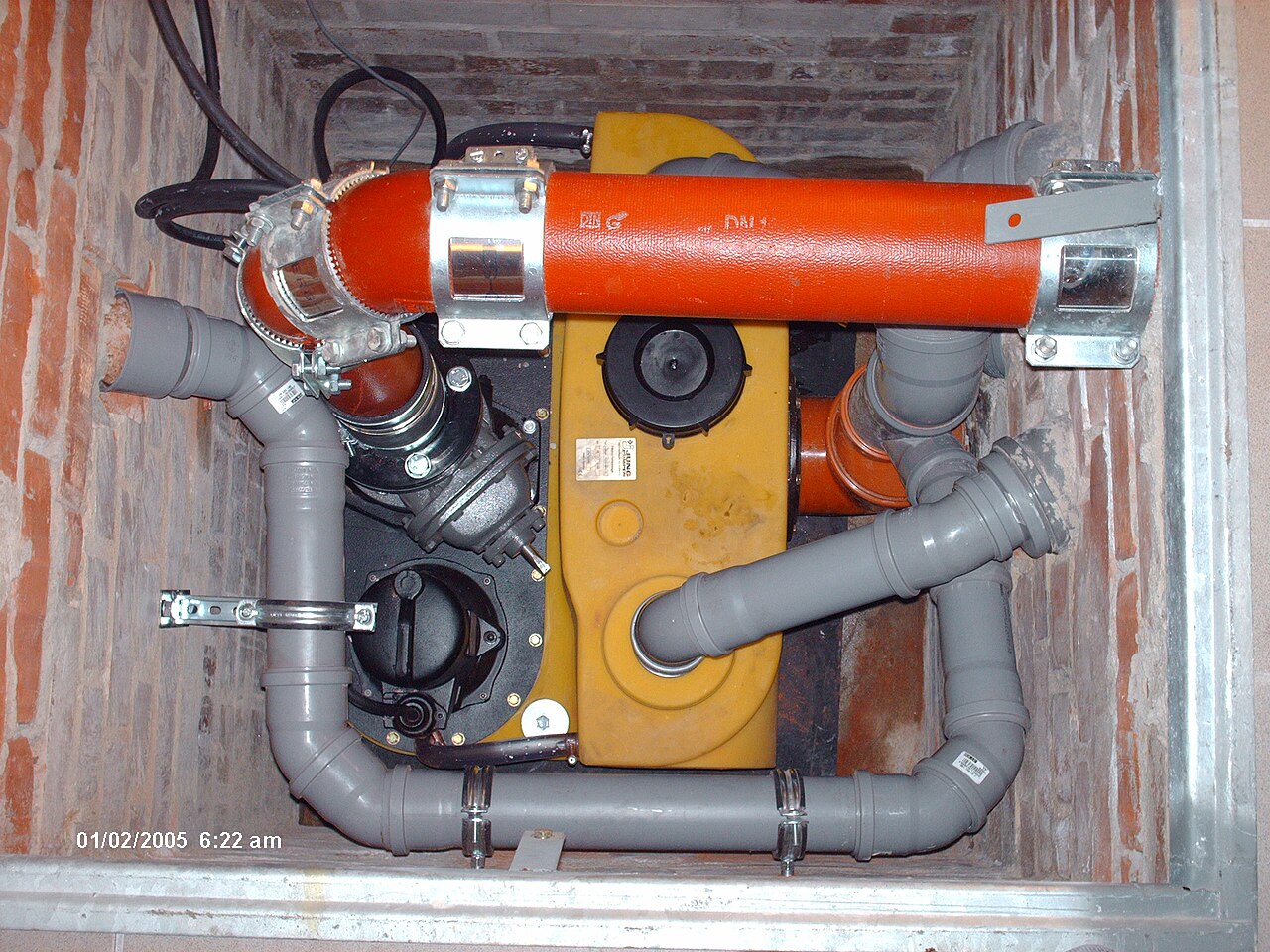
A packaged shaft station compresses wet well, pumps, guide hardware and discharge piping into one volume. That compactness makes level band, access and removal clearance inseparable.
Jung Pumpen GmbHCC BY-SA 4.0Wikimedia Commons
8.1.2The worst cycling inflow is not the peak inflow
At very small inflow the well takes a long time to fill. As inflow approaches pump delivery, drawdown takes a long time. The shortest cycle lies exactly between them, at q = Q/2. That result matters because checking only average and peak flow can miss the inflow that produces the most starts. The instrument below moves inflow through the whole admissible range and makes the minimum visible.
If a motor supplier permits N starts per hour, the shortest acceptable cycle is 3600/N seconds and the one-pump effective volume is Q × 3600/(4N). Multiple pumps, variable-speed control, unequal duty units and changing system head require an operating-sequence simulation; the one-pump result remains a useful lower-bound check, not a complete station model.
Interactive lab bench
The wet well is a clock — find its fastest cycle
A 3D instrument you drive yourself, one variable at a time. It needs JavaScript and WebGL, so it is not shown in this static copy of the page.
Intuition says the shortest cycles happen at peak inflow. The opposite is
true. Cycle time for a single fixed-speed pump is
t = V/(Qp − Qi) + V/Qi, and that
expression is minimised when inflow is exactly half of pump capacity. At
very low inflow the fill time is long; at inflow approaching pump capacity the
pump-down time is long. In between, both are short at once.
So the starts-per-hour limit is not tested at design peak. It is tested at Qi = Qp/2, which for a station sized on peak flow is an entirely ordinary Tuesday morning.
Size the active wet well volume from the cycle time at Qi = Qp/2 against the motor's permitted starts per hour (typically 6–10 for larger units). Checking only at peak flow will pass a wet well that burns out a motor.
8.1.3The same volume that protects the motor can spoil the sewage
More effective volume lengthens cycles, but it also increases residence time. In a sanitary station, long detention consumes dissolved oxygen and can create septicity, odour, hydrogen sulphide and downstream corrosion. The design is therefore squeezed between a short-cycling floor and a detention ceiling. There is no honest way to resolve that squeeze without the site flow pattern, temperature, upstream travel time and the owner’s odour-control criteria.
The useful first screen is detention = usable stored volume / representative inflow. It is a hydraulic age, not a sulphide prediction. EPA’s Odor and Corrosion Control manual notes that pump-station wet wells are common sulphide locations and that acceptable detention depends on wastewater characteristics and design flow. If the cycling volume required by the motor produces excessive age at low flow, change the sequence, use smaller duty pumps, vary speed, or reduce the active area. Do not merely lower the alarm level.
8.1.4Geometry must return solids to the pump
A flat floor and dead corners turn a hydraulic reservoir into a solids store. Benching should fall toward the pump inlets, avoid shelves behind guide rails and leave access for cleaning. The exact slopes and clearances belong to the pump supplier’s intake geometry and the local owner’s standard. The physical test is universal: at pump-off, settled material should not be stranded in a quiet pocket that the next cycle cannot reach.
- Too little volume: repeated starts heat the motor and starter; level instruments may hunt between set points.
- Too much active volume: sewage ages, solids settle and the well becomes an odour reactor.
- Too little volume below pump-off: vortices and air ingestion appear before the level switch stops the pump.
- Poor benching: grease and grit accumulate even when every level calculation is correct.
Lab 8.1
Implement minimum cycling volume
Write wetWellVolume(pumpM3s, maxStartsPerHour) returning the minimum effective volume in m³ for one fixed-speed pump. Use the analytic worst case at inflow Q/2 . Graded in the browser against 2 assertions; the editor and harness require JavaScript.
Check your understanding
Check the cycle
2 auto-graded questions with an explanation for every wrong answer. Requires JavaScript. (m8-l1-q1)
The wet well is not spare volume. Every cubic metre belongs to a level, a time and a failure it prevents.