§ 8.2 Module 8 — The Station Itself: Elements, Details and Failures
What Arrives With the Water
A solids strategy does not remove maintenance. It chooses where maintenance happens.
By the end of this lesson
- Choose a screening or solids-handling strategy for a duty
- State and source the solids-passage requirement for a raw-sewage pump
- Predict the maintenance consequence of a given choice
8.2.1Wastewater carries objects, not just a concentration
Hydraulic calculations treat sewage as a liquid with density and viscosity. The pump receives rags, wipes, fibres, grit, grease and occasional objects whose size and tensile strength are not represented by either. EPA documents the practical result plainly: wipes can clog pipes and pumps, and rope-like rags wrap impellers. A station can pass every duty-point calculation and still require a weekly callout.
The first decision is a chain-of-custody decision. A screen intercepts material before the pump, but creates screenings that must be raked, washed, compacted, stored and hauled. A grinder reduces some solids, but can turn a visible blockage into fibres that re-form downstream. A non-clog pump passes more material, but transfers the duty to the force main and treatment works. None makes solids disappear.
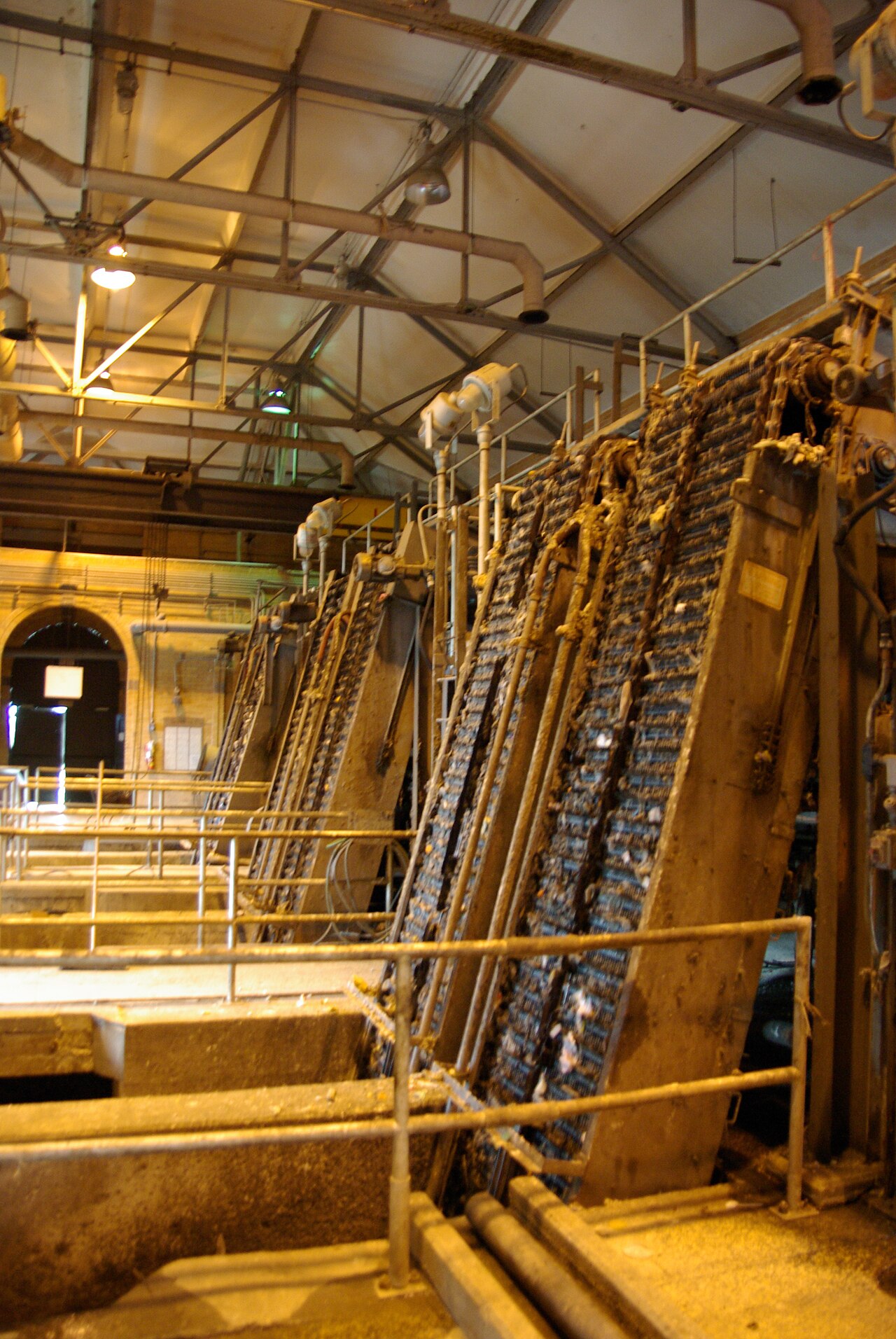
Mechanical screens turn incoming debris into a maintenance stream. The hydraulic opening is only half the design; lifting, cleaning, storage and disposal remain visible beside it.
Kristian Bjornard from Baltimore, MarylandCC BY-SA 2.0Wikimedia Commons
8.2.2A screen is a hydraulic opening and a maintenance machine
For preliminary sizing, the net open area is Aopen = Q/v. If bars occupy a fraction of the gross channel, Agross = Q/(v × open fraction). Velocity that is too low drops grit upstream; velocity that is too high drives headloss and pins flexible material to the bars. Acceptable approach and through-screen velocities are equipment- and owner-specific. The calculation exposes area; it does not select a screen.
The screen must also survive its unavailable state. Provide a duty/standby path, a bypass governed by the owner’s overflow policy, or enough upstream storage to isolate and clean it. EPA’s combined-sewer screen fact sheet specifically calls for access, grit-removal provisions and backup capacity. A screen that cannot be removed without stopping the station is not maintainable redundancy. See EPA’s Combined Sewer Overflow Technology Fact Sheet: Screens.
Intercepted material needs lifting, drainage, storage, odour control and disposal. A screen that protects the pump but cannot be maintained during peak inflow creates a different station failure.
Draw the screenings path and the bypass/maintenance condition with the same care as the water path.
8.2.3Solids passage is a declared geometry, not an adjective
A raw-sewage pump specification should state the required free passage and how it is demonstrated. “Non-clog” is a product family, not a dimension. Some owners require passage of a named spherical solid; Brunswick County, North Carolina, for example, specifies a 3 in (76 mm) sphere for its own minimum 4 in piping. That is useful evidence of local practice, not a universal minimum for every pump station.
Passage diameter alone also misses stringy material. Review the impeller inlet, vane leading edges, wear clearances, rotation direction and the manufacturer’s ragging test evidence. A large nominal sphere can pass through an opening while a long wipe catches on the same edge and winds into a rope. State both the hard-solids requirement and the fibrous-solids duty.
The changing solids load
Sewerage equipment was developed around material that dispersed in water. Modern wet-strength wipes are designed to remain intact during use; EPA research and public guidance identify that strength as a pump and collection-system problem. Existing stations can therefore acquire a new failure mode without any change in flow, head or pipe size.Interactive 3D instrument
Choose where the solids become maintenance
A 3D instrument you drive yourself, one variable at a time. It needs JavaScript and WebGL, so it is not shown in this static copy of the page.
8.2.4Predict the visit before choosing the machine
Turn the selection into an operations balance. Estimate captured mass per day, bin capacity, cleaning water, lifting route and the safe task needed after a jam. A screen with 95% capture and a small bin may demand more visits than a coarser screen with a deliberately scheduled downstream cleanout. The “better” capture percentage is not better if operators cannot service the result safely.
- Rising wet-well level plus falling pump current: suction obstruction or loss of prime is plausible.
- Rising current plus falling flow: ragging, a restricted discharge or mechanical drag is plausible.
- Frequent screen differential-level alarms: excessive loading, blinded bars or a failed rake—not necessarily excessive station inflow.
- Clean pumps but downstream blockages: the station may be successfully transferring the solids problem.
Lab 8.2
Size gross screen area
Write screenArea(qM3s, throughVelocityMs, openFraction) returning gross screen area in m². Use Q = v × Aopen and Aopen = openFraction × Agross . Graded in the browser against 2 assertions; the editor and harness require JavaScript.
Check your understanding
Follow the solids
2 auto-graded questions with an explanation for every wrong answer. Requires JavaScript. (m8-l2-q1)
Solids handling is successful when the maintenance task is known, accessible and scheduled—not merely displaced.