§ 4.4 Module 4 — Head Loss: Everything That Is Not Straight Pipe
Valves as Hydraulic Elements
A throttled valve is a machine for converting electricity into warm water. It is very good at it.
By the end of this lesson
- Compare valve types by loss coefficient and by duty
- Explain why a butterfly disc in the flow path costs more than a gate
- Relate a check valve's closing behaviour to the surge module
4.4.1A resistance you are allowed to change
Every other element in this module has one K and keeps it. A valve is the one fitting whose resistance you can move while the station runs, and that is the whole of its hydraulic interest. It does three jobs and only two are yours: isolation, so a pump can be pulled without draining the header; regulation, so the flow sits somewhere other than where the pump would put it; and non-return, which is no job of yours at all — the flow works a check valve, and your only decision is which kind to buy.
The bookkeeping is §4.1's velocity-head method, unchanged: h = K·v²/2g, with K referenced to the pipe's velocity head. Take the station this course has carried since §3.5 — 1 200 m of 250 mm (10 in) cement-lined ductile iron, 60 L/s (951 gpm, 1.37 MGD), 18.0 m of static lift. At that flow the pipe runs 1.2223 m/s (4.01 ft/s), one velocity head is 0.0762 m, friction over the main is 6.504 m and total head is 24.50 m. Now bolt the valves in, wide open:
| Valve, wide open | K | Head at 60 L/s | Cv at 250 mm | Same as … of 250 mm main | What it is for |
|---|---|---|---|---|---|
| Gate | 0.2 | 0.015 m | 6 464 | 2.8 m | Isolation |
| Butterfly | 0.9 | 0.069 m | 3 047 | 12.6 m | Isolation, throttling on clean water |
| Eccentric plug | 1.0 | 0.076 m | 2 891 | 14.1 m | Isolation in sewage |
| Swing check | 2.0 | 0.152 m | 2 044 | 28.1 m | Non-return |
| Ball check | 2.5 | 0.190 m | 1 828 | 35.1 m | Non-return in sewage |
Read the third column before the second. Across the whole family the spread is 0.175 m of head, against 6.504 m for the pipe they are bolted into. Wide open, a valve choice is a duty decision and the loss column is a tiebreak. Two things spoil that. First the check valve, the one valve you cannot open: its 0.152 m (swing) or 0.190 m (ball) is permanent — 503 and 629 kWh a year at 4 000 h/yr and 71.25% wire to water. Second, the moment a valve is part open every number in that table stops applying.
4.4.2Where the head actually goes
A part-open valve does not lose head by rubbing on the wall. It loses head because it makes a jet and then throws the jet away. The flow accelerates through whatever gap the closure member leaves; a short distance downstream it must fill the bore again, and an abrupt expansion cannot recover the kinetic energy it gave up. The loss is the velocity head of the difference of the two velocities: h = (vjet − vpipe)²/2g.
Put numbers on it. Turn that 250 mm butterfly to half travel — the disc at 45° — and the gap is 29.3% of the bore. The pipe still runs 1.2223 m/s; the gap runs 6.476 m/s, and the jet carries 2.138 m of velocity head where the pipe carries 0.076 m. Of that, 1.407 m is destroyed in the expansion and the rest recovers as pressure. Add the 0.069 m the valve was costing wide open and it now takes 1.476 m — twenty-one times as much, from a handle that moved half way.
The law is older than the valves
The result predates plumbing. Jean-Charles de Borda presented his memoir on the discharge of fluids through orifices to the Académie Royale des Sciences in Paris in 1766, and Lazare Carnot reached the same conclusion from the mechanics of machines in his Essai sur les machines en général of 1783: when a stream expands abruptly, the energy lost is the kinetic energy of the velocity difference. It is still called the Borda-Carnot loss.
Giovanni Battista Venturi published his Recherches expérimentales sur le principe de la communication latérale du mouvement dans les fluides in Paris in 1797, showing the other half: a gradual expansion gives the pressure back. A century later, in 1887, Clemens Herschel, then engineer to the Holyoke Water Power Company in Massachusetts, turned that into the Venturi meter — a deliberate constriction that measures flow at almost no cost in head, its downstream cone long enough that the jet never separates.
Which is the cleanest way to say what a valve is: a Venturi built the other way round, contracting the flow on purpose and discarding the recovery. The gradual reducer of §4.3 is on Venturi's side of that line at K = 0.15; a valve at 17% open is as far from it as a fitting gets.
Two consequences follow, and they are the rest of the lesson. The loss is set by the area the flow must pass, not by how far the handwheel turned — different things. And because jet velocity goes as 1/area while the loss goes as the square of the velocity difference, the loss goes roughly as the inverse square of the free area. Halve the gap and you quadruple the bill.
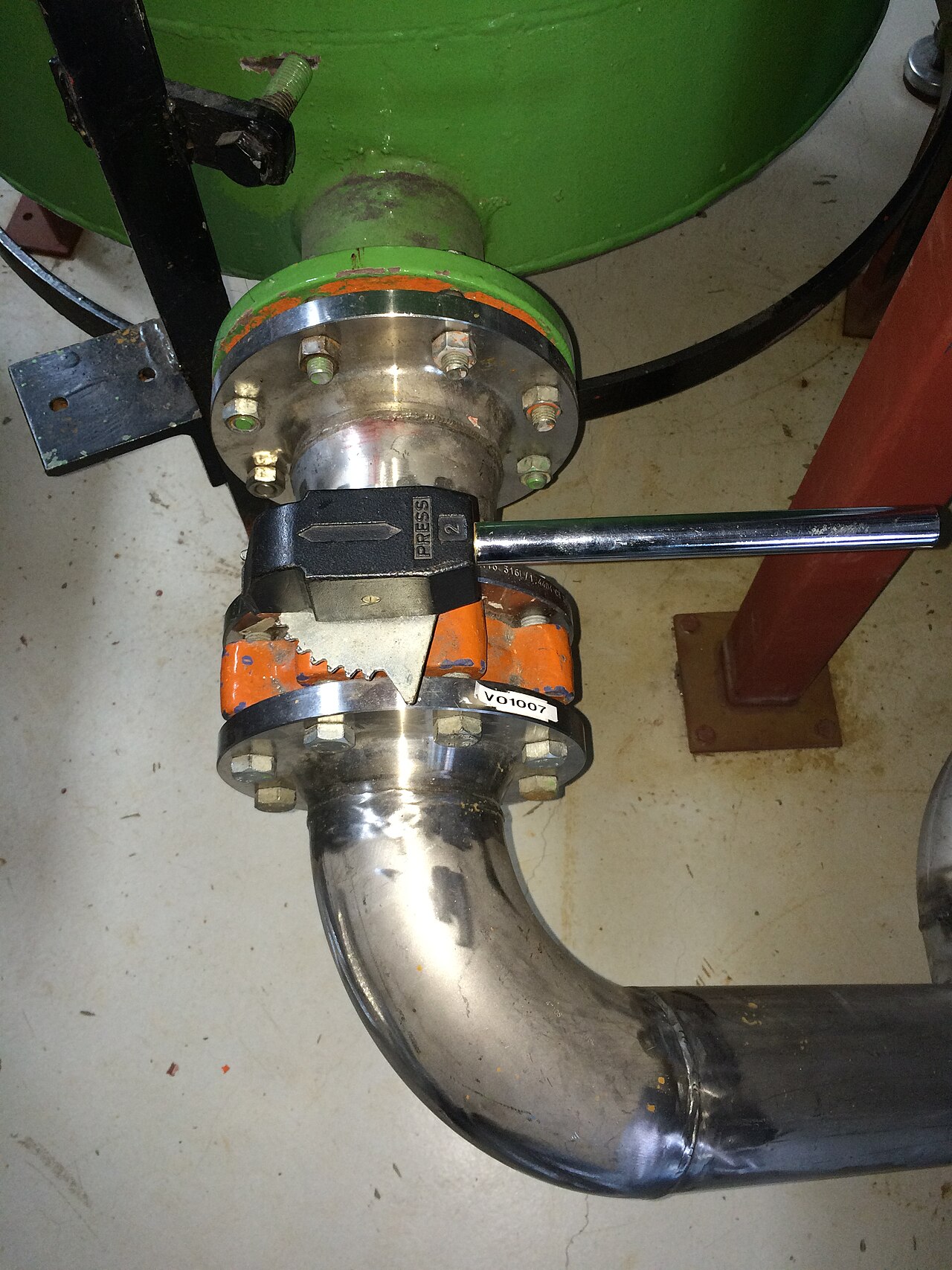
The disc remains in the flow path even when this butterfly valve is fully open. That compact geometry is useful, but its loss and actuator clearance still belong in the station layout.
BitjungleCC BY-SA 4.0Wikimedia Commons
A valve shown open may have a disc in the stream, a failed actuator, an incorrect travel stop or a check element hovering partly open. Its real loss can exceed the schedule.
Connect the assumed position to the selected valve, actuator and commissioning test, and provide pressure taps where the consequence matters.
4.4.3Percentage open is not percentage of anything
How travel becomes area is pure geometry, and it differs by valve. A gate withdraws a flat disc across a circular bore, so the free area is a circular segment of height x·D — the same part-full-pipe geometry Module 3 uses for a sewer. There is one coincidence in it: at half travel a gate uncovers exactly half the bore, because a circle is symmetric about its diameter. Elsewhere it is nothing like proportional — 5.2% of the bore at a tenth of travel, 19.6% at a quarter.
A butterfly disc does not withdraw; it rotates, and at angle α from closed it projects an ellipse of area (π/4)D²·cos α over the bore. The free area is therefore 1 − cos α: 29.3% at 45°, and only 50% at 60° — two thirds of the travel to reach half the bore. Then area becomes K through the expansion, and that step is worse than the first:
| Butterfly travel | Disc angle | Free area | K | Head at 60 L/s | Against the 1 200 m main |
|---|---|---|---|---|---|
| 100% | 90° | 100% | 0.90 | 0.069 m | 1.1% |
| 67% | 60° | 50.0% | 4.23 | 0.322 m | 4.9% |
| 60% | 54° | 41.2% | 7.57 | 0.577 m | 8.9% |
| 50% | 45° | 29.3% | 19.4 | 1.476 m | 22.7% |
| 38% | 34° | 17.0% | 72.2 | 5.50 m | 84.6% |
| 30% | 27° | 10.9% | 194 | 14.79 m | 227% |
| 20% | 18° | 4.9% | 1 050 | 80.0 m | 1 230% |
Three habits come out of that table. Read the bottom two rows as a warning about the model, not a design case: below roughly 15–20% open it describes a geometry the valve is not permitted to sit in — manufacturers set a minimum continuous opening and a maximum differential for throttling duty, and a disc at 18° carries a dynamic torque its shaft may not be sized for. Second, the useful control range of a quarter-turn valve is a narrow band in the middle, and the sensitivity there is brutal: 5.50 m to 6.50 m is 1.4 points of travel. Third, a tabulated K is a wide-open K, and quoting it for a part-open valve is not conservative — it is out twentyfold.
Why the operator is sure nothing happened
Close that butterfly to half travel and the head across it rises 21-fold, 0.069 m to 1.476 m. Ask the flow meter and it reports almost nothing: 1.476 m against 24.50 m of total head is 6%, and on a system curve mostly made of static lift the flow barely moves. Wide open the valve was 0.28% of the station's head — it has no authority over the flow until it is destroying real energy.
Control-valve practice has language for this that pump-station practice lacks. The catalogue curve of Cv against travel — linear, equal-percentage, quick-opening — is the inherent characteristic, measured at constant differential; bolted into a system whose head is mostly elsewhere it becomes the installed characteristic, a different shape. Read the control-valve literature (Fisher's Control Valve Handbook, the ISA S75 standards), not the pump handbooks. How far the flow moves needs a pump curve: §7.2.
Interactive 3D instrument
Percentage open is not percentage of anything
A 3D instrument you drive yourself, one variable at a time. It needs JavaScript and WebGL, so it is not shown in this static copy of the page.
4.4.4What a throttle costs, and what the alternatives cost
Now the case that puts a valve part open and leaves it there for a year. The station needs 24.50 m at 60 L/s and the pump, for reasons that are Module 6's business, produces 30.0 m there. Something must absorb 5.5 m (18.0 ft), and the cheapest thing to buy is a valve. Closing it until it takes 5.5 m means dialling in K = 72.2 — the head over one velocity head, 5.50/0.0762 — which on a butterfly is 37.7% of travel, a disc angle of 33.9°, and 17.0% of the bore left open. The gap runs 11.54 m/s and the valve's Cv has fallen from 3 047 to 340.
Price it three ways, because each persuades a different reader. In pipe — §4.2's equivalent length, Le = K·D/f: 5.5 m at this flow is the friction of 1 015 m of the 250 mm main, 85% of a second force main inside one casting. In power: 3.233 kW of water power (ρgQh) becomes 4.538 kW (6.09 hp) at the wire once the pump's 75% and the motor's 95% are paid, the 71.25% basis §3.5 used. In energy: 0.0210 kWh/m³ of specific energy, which over 4 000 hours and 864 000 m³ is 18.2 MWh a year — against 99.0 MWh for the whole station at 30.0 m, or 80.9 MWh without the throttle. The valve is 18.3% of the bill, for ever, and it is the only component here whose entire function is to be a loss.
Against what? Rank the alternatives by where the head goes, not by capital cost. Trim the impeller or slow the pump and the 5.5 m is never produced: the whole 4.538 kW disappears rather than moving elsewhere, which is why §6.6's variable-speed drive is the honest answer to a surplus and a valve is the expedient one. Buy the smaller pump, if the error is caught before the order. Accept the extra flow, if the main, the wet well and the receiving works can take it. And one that does not work: enlarging the force main increases the surplus, because it lowers the head the system demands. "The pipe is too small" is the reflex diagnosis at a throttled valve, and here it is backwards.
None of which makes throttling illegitimate. It is the right tool for filling a main slowly, for commissioning tests, for a temporary duty while a permanent fix is procured, and for flow control by a valve designed for it — enough authority, a published characteristic, a body rated for the differential. Never on the suction side: throttling upstream of a pump lowers the pressure at the impeller rather than the flow, which is §6.5's NPSH problem. A suction isolation valve is shut for maintenance and open the rest of the time.
Lab 4.4
Price a throttle, and convert to the currency a manufacturer speaks
Four functions. Between them they answer the two questions a part-open valve raises on site — what is it costing, and what opening is it actually at — and they convert into C v , which is the only valve number anybody will warrant. valveHeadM(K, qM3s, dM) — the velocity-head method: h = K·v²/2g, in metres , for a circular pipe of inside diameter dM metres. G and RHO are provided in the sandbox. Zero flow must give exactly zero, not NaN. kForHead(headM, qM3s, dM) — the inverse, and the one an operator wants: the K that destroys a given head at a given flow. It is what you dial a valve to. cvFromK(K, dInches) — the conversion into US flow-coefficient practice, C v = 29.9·d²/√K, with d in inches and C v in gpm per √psi. The 29.9 is not arbitrary; it falls out of the same h = K·v²/2g once the units are converted, which is why the test below checks your answer against a first-principles SI calculation as well as against the tabulated form. wireKw(headM, qM3s, pumpEff, motorEff) — what the destroyed head costs at the wire, in kilowatts: ρgQh divided by both efficiencies, which are passed as fractions. Graded in the browser against 7 assertions; the editor and harness require JavaScript.
4.4.5Choosing by duty, and what is not in this ledger yet
Selection reads better as duties than as a ranking by K, because the loss column only decides between valves that can both do the job:
- Isolation, sewage. Eccentric plug or knife gate: full port, no seat for rags to hang on. K = 1.0, 0.076 m here.
- Isolation, clean water. Resilient-seated gate below about 300 mm, butterfly above, where a gate becomes large, heavy and slow. K = 0.2 and 0.9 — 0.015 m and 0.069 m here.
- Throttling, clean water. Butterfly within the manufacturer's opening and differential limits, or a purpose-made control valve for a continuous duty. Never a gate: a part-open gate wire-draws its seat, and opening it again does not undo that.
- Non-return. Swing check on clean water, ball check on sewage; K = 2.0 and 2.5, paid whenever the pump runs. The selection is really about closing behaviour — §8.4.
- Air. Not covered here. High points on a force main need air valves, and their absence is a capacity problem masquerading as a friction problem.
The check valve earns its reputation as the station's most expensive fitting twice over. Hydraulically it is the largest single K in the discharge train and the only one that cannot be opened: 503 kWh a year for a swing check here, 629 for a ball check. Operationally it is worse, because it is the one valve that moves on its own, and how fast it moves when the pump stops sets the surge the main sees — §8.4 and §8.5. Its K says nothing whatever about that. A fitting can be hydraulically trivial and dynamically the most dangerous object on site.
What this ledger still leaves out. The pump curve, so the flow change a closing valve produces is §7.2. Cavitation in the valve itself: 5.5 m of differential on a cold force main is harmless, but a high-differential throttle on a low-pressure line cavitates in the jet and eats the body downstream of the seat — and the check for that is a cavitation index, not a K. Actuator torque and leakage class, procurement facts with hydraulic consequences. And one caution covering every minor loss in this module: these K values assume an undisturbed approach. A valve bolted onto an elbow, or two valves flanged together, sees a distorted profile and does not lose the catalogue value — closely coupled fittings do not simply add. Use the manufacturer's required straight-run lengths or tested assembly data.
Check your understanding
Check your understanding
3 auto-graded questions with an explanation for every wrong answer. Requires JavaScript. (m4-l4-q1)
Every valve figure here comes from the model in src/scenes/m4/valve-losses.js, checked by sixteen verifiers against the published sudden-expansion coefficient, numerical quadrature of both closure geometries, the tabulated Cv = 29.9·d²/√K and Kv = 0.865·Cv relations, the equivalent-length identity and an SI/US customary cross-check — and hardened by sixteen deliberate mutations, all of which the verifiers caught. The part-open K curve is a physical model, not a manufacturer's curve; for a real selection, get C<sub>v</sub> against travel in writing.