§ 8.4 Module 8 — The Station Itself: Elements, Details and Failures
Check and Isolation Valves
One valve permits maintenance. The other prevents the main from giving the water back.
By the end of this lesson
- Place isolation and check valves correctly and justify each
- Match a check valve type to the surge behaviour it produces
- Recognise the symptoms of a chattering or partly-open check valve
8.4.1Two valves, two different promises
An isolation valve is commanded and stays where it is put; it creates a safe maintenance boundary. A check valve is automatic; forward flow opens it and reversal closes it. Treating the pair as generic “valves” loses the reason for both. The check protects an idle pump from reverse flow, while the isolation valve lets that check or pump be removed without draining the header.
A common discharge order is pump, check valve, then isolation valve toward the header. The check is close to the pump so the reverse volume between them is small; the downstream isolation valve can then separate both pump and check from a live header. Suction isolation is also needed for a dry-installed pump. Exact arrangement, bypass and access follow the station type and owner standard; the maintenance boundary must be traceable on the drawing.
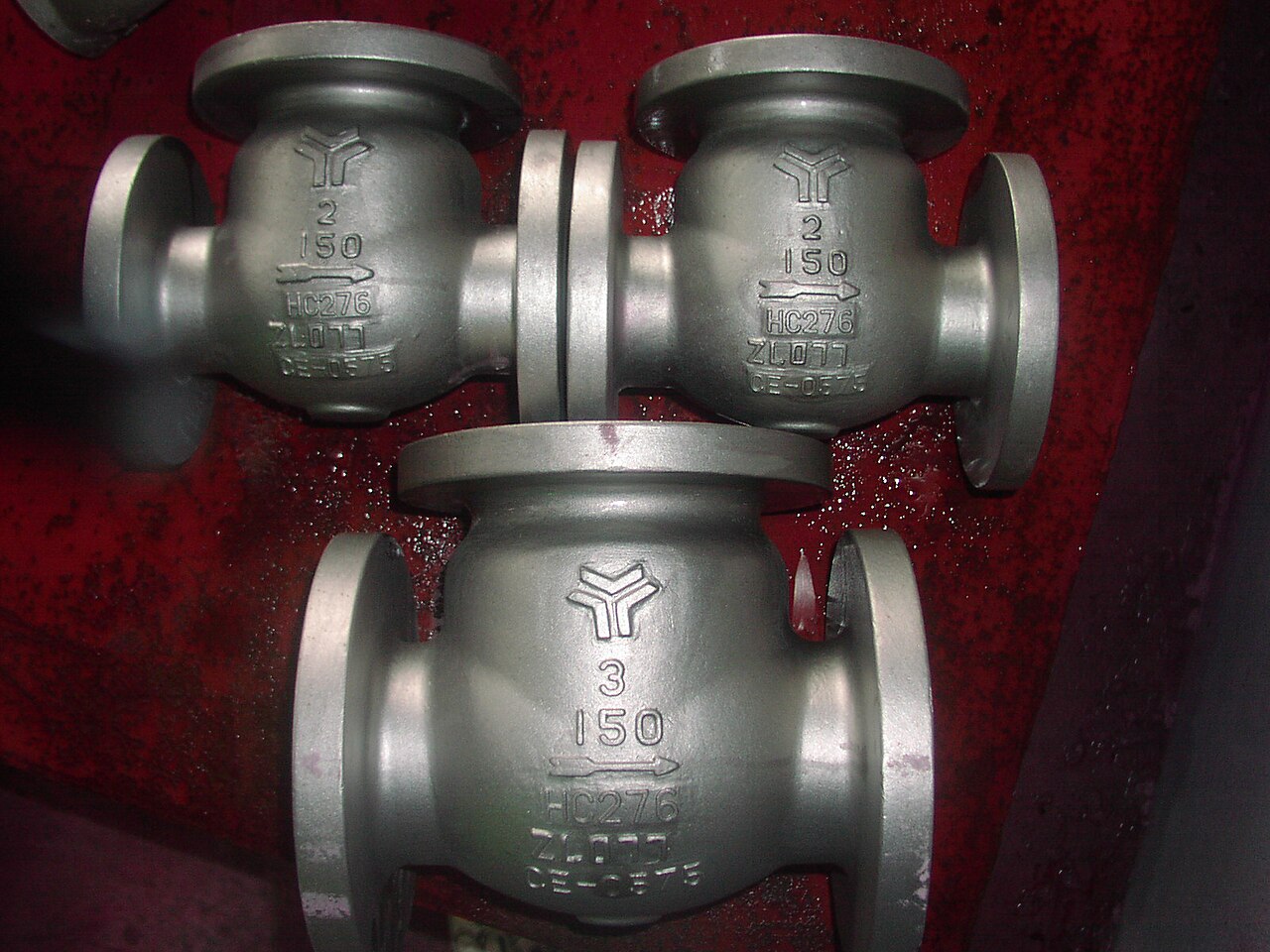
The hinged discs and broad bodies show why a check valve has dynamics as well as a loss coefficient. Disc travel, inertia and reverse velocity decide how closure behaves.
Heather SmithCC BY 3.0Wikimedia Commons
8.4.2Closing early and closing gently are not the same thing
After power loss, forward velocity decays. A check disc with low inertia and suitable spring assistance can meet the seat near zero velocity. A heavy swing disc may remain open until reverse flow accelerates, then stop that flow abruptly. The impact is the audible slam; the pressure wave it launches is surge. An external lever or position switch makes movement observable, but it does not by itself make the closure safe.
A cushioned or controlled valve changes closing time, which can reduce slam in one system and worsen reverse flow or column separation in another. Selection must use the transient behaviour of this force main. Seattle Public Utilities, for example, calls for a check immediately downstream of a pump and isolation around removable equipment; that is a named owner standard, not a universal detail for every jurisdiction. See SPU Design Standards and Guidelines, Chapter 11.
The check valve exists so that flow does not reverse through a stopped pump. It does that by slamming shut, and the slam is a water hammer event generated inside your own station. A heavy swing disc closing on reversing flow can produce a pressure spike comparable to the surge you carefully designed the force main to avoid.
The trade is real and there is no free option: fast closure means a hard slam, slow closure means reverse flow through the pump and possible reverse rotation. Valve type is the lever — spring-assisted, lever-and-weight, tilting disc, or a cushioned closure — and each buys a different part of the curve.
On any force main long enough for surge to matter, select the check valve as part of the surge analysis rather than as a catalogue item after it. The valve's closure characteristic is an input to the transient model, not a detail.
8.4.3A check that never fully opens becomes a control valve by accident
At flow below its stable opening range, the disc can hover, strike its stop and fall back: chatter. The station may show a rattling valve, oscillating discharge pressure and accelerated hinge or seat wear. If the disc remains partly open, its loss coefficient rises, duty flow falls and motor power can move in a direction that depends on the pump curve. “The motor is not overloaded” therefore does not clear the valve.
A pressure tap on each side of the valve and a trustworthy flow measurement make the failure visible. Compute K = 2gΔh/v² at a stable flow and compare it with the accepted commissioning baseline for that valve, orientation and opening. Catalogue K values are screening estimates; an in-service differential is evidence.
Interactive lab bench
Close before reverse flow becomes a hammer
A 3D instrument you drive yourself, one variable at a time. It needs JavaScript and WebGL, so it is not shown in this static copy of the page.
8.4.4The valve must be maintainable in the state that proves it failed
A check valve needs room to remove its cover, withdraw its hinge or ball and lift the heaviest part. An isolation valve needs visible position, an operable handwheel or actuator, and a lockout boundary that does not depend on a leaking check seat. Put drain and pressure-release provisions on trapped volumes. A valve vault that floods to the flange line has converted routine inspection into confined-space and contamination work.
Inspection guidance follows the sound
EPA sanitary-survey guidance tells inspectors to observe centrifugal-pump check valves during start and stop and to investigate valves that slam, because main breaks can follow pressure surge. The old diagnostic remains useful: listen—but confirm it with pressure, position and flow before changing hardware.- Single hard impact at shutdown: late closure after reverse velocity has developed.
- Repeated impacts while running: chatter near an unstable opening position.
- High differential and low flow: obstruction, worn mechanism or a partly-open disc.
- Reverse pump rotation after trip: leakage or failed closure; isolate before inspection.
Lab 8.4
Infer an in-service valve K
Write valveK(deltaHeadM, velocityMs) using Δh = K v²/(2g) . Use g = 9.80665 m/s² . Graded in the browser against 2 assertions; the editor and harness require JavaScript.
Check your understanding
Read the valve train
2 auto-graded questions with an explanation for every wrong answer. Requires JavaScript. (m8-l4-q1)
A valve schedule names sizes. A defensible valve design also names states, boundaries and closure behaviour.