§ 8.5 Module 8 — The Station Itself: Elements, Details and Failures
Surge: Water Hammer and Protecting the Main
Steady head sizes the duty. The fastest credible change tests whether the pipe survives it.
By the end of this lesson
- Compute wave speed and the Joukowsky head rise for a stop
- Decide whether a closure is hydraulically fast using the pipe period
- Select surge protection appropriate to the mechanism at work
8.5.1A pressure change travels before the whole column stops
The steady energy equation assumes one flow at one time. A pump trip or rapid valve movement changes velocity locally, compresses the liquid and stretches the pipe. That disturbance travels as a pressure wave. For an instantaneous change in a full liquid column, the Joukowsky bound is ΔH = a ΔV/g, where a is wave speed and ΔV is the velocity change.
Wave speed is not “the speed of water”. In a rigid pipe it approaches the acoustic speed of the liquid; a flexible wall stores strain and lowers it. A useful thin-wall form is a = √[(K/ρ)/(1 + KD/(Ee))]. Restraint, viscoelastic pipe response, entrained gas and lining details can require a more complete relation. Use material data and transient software appropriate to the design.
a = √[(K/ρ)/(1 + KD/(Ee))]       wave speed, m/s
ΔH = a ΔV/g                    Joukowsky head change, m
Tpipe = 2L/a                   wave round trip, s

If the effective velocity-change time tc ≤ Tpipe,
the event is hydraulically fast for this screening model.
A transparent upper-bound screen, SI units throughout.
8.5.2Fast is measured against the pipe, not a stopwatch
The same 2 s closure can be slow on a short rigid line and fast on a long flexible one. Compare effective closure time with the force main wave period 2L/a. For a 1,200 m main with a = 900 m/s, the period is 2.67 s; stopping 1.5 m/s of flow within that time gives a Joukowsky screen of 137.7 m of head. Those three results are checked by the exercise and scene verifier.
Joukowsky is a bound for one velocity change in a liquid-full line. It does not predict reflections at diameter changes, pump inertia, check-valve reopening, relief-valve dynamics or vapour cavities. USACE guidance presents 2L/a and aV/g as the first screening calculations, then recommends computer analysis for large stations with long force mains and several intermediate high points. Its stated complexity triggers are agency criteria, not new laws of physics.
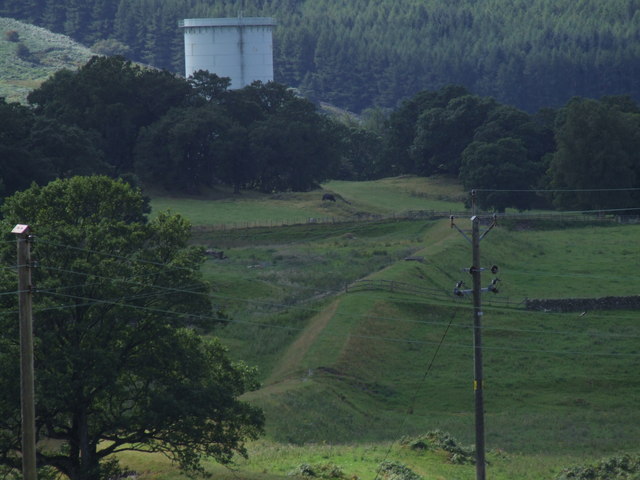
This hydroelectric surge tank is not a municipal pump-station vessel, but it exposes the same protective principle at large scale: give a transient flow somewhere controlled to go.
Paul HookwayCC BY-SA 2.0Wikimedia Commons
Interactive lab bench
Send the pressure wave down the main
A 3D instrument you drive yourself, one variable at a time. It needs JavaScript and WebGL, so it is not shown in this static copy of the page.
ΔH = a·ΔV/g is taught as the maximum surge, and for a
frictionless line with closure faster than the pipe period 2L/a it is.
Two caveats change how you use it.
First, it only applies to rapid closure. Close slower than 2L/a and the returning pressure wave relieves the spike, so the real surge is less — sometimes much less. Second, in long lines where friction head is a large fraction of the total, "line packing" can drive the pressure at the valve above the Joukowsky value as the flow decelerates against the frictional gradient. Treating Joukowsky as an unconditional ceiling in that case is optimistic.
Neither caveat is a reason to skip the estimate. Joukowsky is the right first calculation — it tells you in one line whether surge is a footnote or a governing load case.
Use Joukowsky to screen. If the result is a meaningful fraction of the pipe's pressure rating, or if the line is long relative to its wave period, escalate to a proper transient analysis rather than adding a safety factor to a formula that is outside its assumptions.
8.5.3The minimum pressure can govern before the maximum does
A pump trip first removes head. On a rolling profile, the hydraulic grade line can fall to vapour pressure at a summit while pressure at the station later rebounds upward. A vapour cavity then collapses when returning columns meet, creating a local spike larger than the simple initial change suggests. Designing only for positive water hammer can therefore miss the destructive mechanism.
Plot maximum and minimum transient envelopes against pipe class, allowable vacuum, support loads and every high point. Include credible states: power failure with all pumps running, one-pump trip, controlled stop, check-valve failure and device unavailable. A surge device is not credited merely because it appears on the schematic.
8.5.4Match the protection to the mechanism
- Slow the velocity change: pump inertia, controlled valve motion or a VFD stop can reduce the initiating wave, subject to power-loss behaviour.
- Supply or accept volume: hydropneumatic tanks and surge vessels limit pressure change by exchanging water with the main.
- Limit positive pressure: a relief valve opens to a safe destination, but its setting, capacity and response must be modelled.
- Admit and release air: a correctly selected wastewater air/vacuum valve can protect a high point, while creating air-management and odour duties.
- Change the pipeline: lower velocity, different pressure class or a revised profile can remove the mechanism rather than treating it.
From bang to wave
Early descriptions took the audible hammer as the event. Elastic-column analysis reframed it as travelling information: a boundary changes, a wave carries that change, and reflections assemble the later extremes. That is why a long line cannot be represented by one lumped volume when closure is fast.Lab 8.5
Compute the surge screen
Write surgeScreen(lengthM, waveSpeedMs, deltaVelocityMs, closureS) returning {periodS, deltaHeadM, fast} . Use g = 9.80665 m/s² and define fast as closureS <= 2L/a . Graded in the browser against 2 assertions; the editor and harness require JavaScript.
Check your understanding
Read the transient
2 auto-graded questions with an explanation for every wrong answer. Requires JavaScript. (m8-l5-q1)
Joukowsky is the first question in a surge review, not permission to stop asking questions.