§ 8.6 Module 8 — The Station Itself: Elements, Details and Failures
Controls, Power and Safety
The last layer is the one that must still work when the station does not.
By the end of this lesson
- Specify a level-control and duty-rotation scheme and say what it protects
- Determine the standby power a station needs from its storage time
- State the hazards of a wet well and the controls that manage them
8.6.1A level sequence is a failure sequence written in advance
A duplex sanitary station commonly progresses through pump-off, lead start, lag start and high-high alarm as level rises. The gaps provide stable hysteresis; the order provides capacity before overflow. On the next normal cycle, lead duty rotates so runtime and starts are shared. Rotation is not cosmetic fairness: it reveals a weak unit before an emergency needs both.
Do not give one level transmitter every job. A maintainable scheme uses an independent high-high device or diverse technology, local hardwired fallback where risk requires it, and telemetry that distinguishes instrument fault from genuinely high water. Test each state from sensor to alarm destination. A perfect screen graphic is not proof that a relay, radio path and callout roster form a working protection layer.
The sequence also protects the firm-capacity promise. Lead failure must cause lag start and a specific alarm; both-pump demand must not silently alternate back to one pump; restoration after power loss must avoid simultaneous motor starts unless the electrical system is designed for them.
8.6.2Storage converts a power failure into a deadline
With pumps unavailable and no useful downstream relief, time to the critical level is t = Vavailable/Qin. This is a deadline, not standby capacity. Compare it with generator automatic-start time, operator travel time, portable-generator connection time and the duration of the credible outage. If the shortest credible response exceeds storage time, standby pumping must start automatically or additional storage and a controlled overflow plan must be provided under the governing permit.
Generator sizing then follows the loads required in the emergency sequence: the largest necessary combination of pumps, controls, ventilation, heat trace, lighting and auxiliaries, plus motor-starting voltage-dip and frequency checks. Nameplate kilowatts alone do not prove a generator can start a motor. The selected capacity and transfer scheme belong to the electrical engineer, equipment data and local code; the hydraulic storage clock tells them how quickly the source must be available.
A generator sized only from motor nameplates can miss starting method, simultaneous auxiliaries, fuel duration and the storage consumed before power is restored.
Join the electrical load sequence to wet-well storage, alarm response time and the required pumping state after an outage.
8.6.3Telemetry must report consequence, not merely contact state
Useful remote points include level, pump command and proof, run current, discharge pressure or flow, generator available/running, transfer-switch position, intrusion, wet-well gas or ventilation alarms where fitted, and communications health. Alarm rationalisation assigns priority, delay, destination and the operator action expected. A repeated nuisance alarm trains the response system to fail socially even when every contact closes electrically.
Trend data turns maintenance from anecdote into diagnosis: starts per hour reveal lost cycling volume, widening command-to-proof time reveals a reluctant pump, and rising run current at falling flow points toward ragging or a partly-open valve. Preserve enough history to compare the station with its commissioning baseline.
Interactive minigame
Run the unavailable station before the wet well wins
A 3D instrument you drive yourself, one variable at a time. It needs JavaScript and WebGL, so it is not shown in this static copy of the page.
8.6.4The wet well atmosphere is not warned by smell
Sanitary wet wells can contain hydrogen sulphide, methane, oxygen-deficient air and other contaminants. OSHA warns that H₂S can accumulate in low enclosed spaces, is toxic and flammable, and can rapidly defeat the sense of smell. Opening a hatch is therefore not an atmosphere test.
Apply the jurisdiction’s permit-required confined-space program: identify the space, prevent unauthorised entry, isolate energy and inflows, test the atmosphere from outside in the required order, ventilate, monitor continuously where required, provide an attendant, communications and a rescue method that does not create a second victim. OSHA’s H₂S control guidance specifically calls for pre-entry and continuous monitoring, ventilation and prepared rescue. Local occupational rules may be more stringent and control the actual entry.
The second-victim lesson
Confined-space rules are written around a recurring fatal pattern: an unprotected rescuer enters after a collapsed worker and is overcome by the same atmosphere. Non-entry rescue provisions and a trained attendant are engineering controls against that human impulse, not paperwork added after the hazard.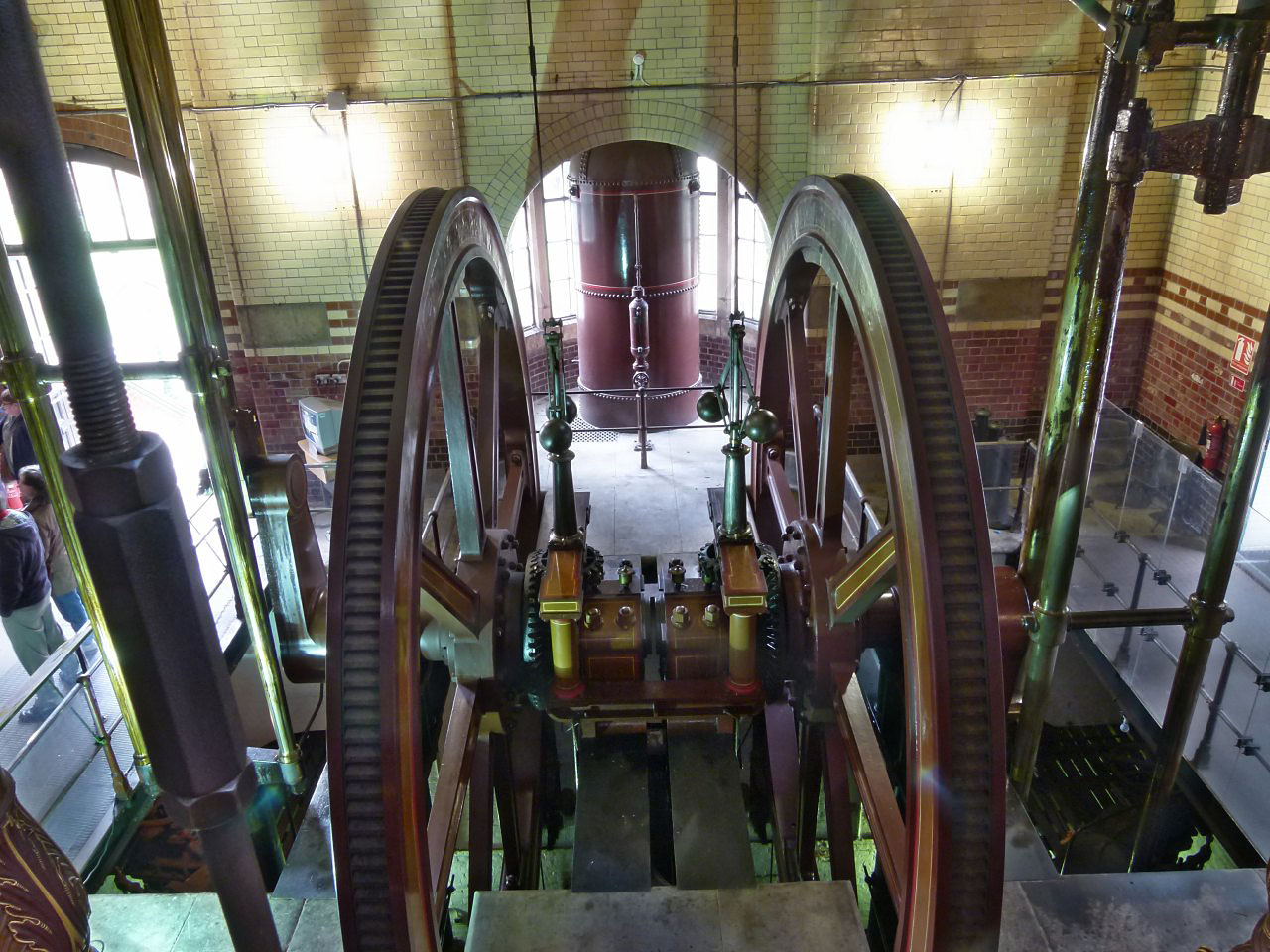
Redundant beam engines at Abbey Pumping Station made duty and standby capacity legible in hardware. Modern controls automate rotation, but they do not remove the reliability requirement.
Alan Murray-RustCC BY-SA 2.0Wikimedia Commons
- Process hazard: sewage, pathogens, sharps, pressure and unexpected inflow.
- Atmospheric hazard: H₂S toxicity, oxygen deficiency, methane and ignition.
- Mechanical/electrical hazard: automatic start, stored pressure, rotating equipment and wet electrical work.
- Access hazard: fall through the hatch, difficult retrieval, traffic and lifting heavy covers or pumps.
Lab 8.6
Compute the power-loss storage deadline
Write storageWindowMinutes(availableVolumeM3, inflowLps) returning minutes until the critical level, assuming no pumping and constant inflow. Graded in the browser against 2 assertions; the editor and harness require JavaScript.
Check your understanding
Design the unavailable state
2 auto-graded questions with an explanation for every wrong answer. Requires JavaScript. (m8-l6-q1)
A station is complete only when its unavailable state has a clock, an alarm, a power source and a safe human response.