§ 6.4 Module 6 — Pumps
Specific Speed and Impeller Shape
A useful index becomes dangerous the moment its unit convention is omitted.
By the end of this lesson
- Compute specific speed in the convention your data uses
- Predict impeller type and curve steepness from specific speed
- Explain why the US and SI scales are not interchangeable
6.4.1A similarity coordinate, not shaft speed
Specific speed locates a pump on the continuum from radial-flow geometry, through mixed flow, toward axial flow. In the common dimensional conventions, Ns = N√Q/H3/4. It is the rotational speed at which a geometrically similar pump would produce one unit of flow at one unit of head—not the rpm printed on the motor.
Use the BEP of one impeller, and for a multistage pump use head per stage. The convention may also specify total pump flow or flow per suction eye for a double-suction impeller. Write those choices beside the number. A bare “specific speed = 2,500” is incomplete engineering.
US customary: Ns = rpm·√(Q_gpm) / H_ft^0.75
SI dimensional: nq = rpm·√(Q_m³/s) / H_m^0.75

For 1,750 rpm, 2,000 US gpm, 100 ft:
Ns = 2,474.87 (US convention)
nq = 47.92 (SI dimensional convention)
The two dimensional conventions
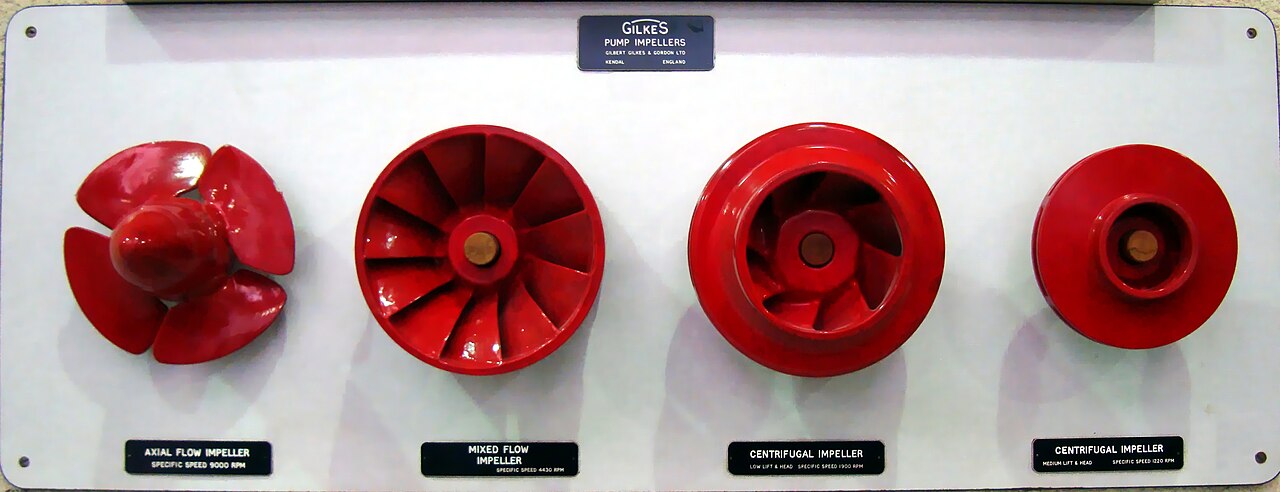
Axial, mixed-flow and radial impellers are physical families, not just regions on a chart. Their changing proportions are what the specific-speed index is trying to describe.
6.4.2The number predicts geometry
Low specific speed means much head relative to flow: a narrow radial impeller throws liquid outward. As specific speed rises, passages widen and discharge becomes increasingly axial. The same progression usually moves the H–Q curve toward the steeper or sometimes unstable shapes associated with mixed- and axial-flow machines, while power and cavitation behaviour change as well.
Category boundaries vary among references and pump families, so treat ranges as a map rather than a procurement rule. The manufacturer’s tested curve outranks a textbook silhouette. Specific speed tells you what shape to expect before seeing the curve; it does not replace the curve.
Similarity made catalogues legible
Once turbine and pump designers organized machines by similarity rather than by diameter alone, apparently unrelated machines fell into families. Specific speed is valuable because it compresses speed, flow, and head into that family coordinate.Interactive 3D instrument
Specific speed changes the silhouette
A 3D instrument you drive yourself, one variable at a time. It needs JavaScript and WebGL, so it is not shown in this static copy of the page.
The same pump has a specific speed of about 2,000 in US practice (rpm, gpm, ft) and about 39 in SI practice (rpm, m³/s, m) — the ratio is roughly 51.6. Despite being called a number, Ns is not dimensionless as normally written, so a value quoted without its unit system is meaningless.
The practical consequence is a mis-selection. Radial, mixed-flow and axial regimes are separated by Ns thresholds, and those thresholds are quoted in whichever convention the source uses. Reading an SI value of 39 against US thresholds puts a perfectly good mixed-flow pump in the radial box.
Always write the unit system next to a specific speed. When comparing against
a published chart, convert your value into the chart's convention first, and
remember suction specific speed Nss is a separate quantity
with the same problem.
6.4.3Why the scales cannot be interchanged
The displayed index changes when gpm and feet are replaced by m³/s and metres. For the same physical duty above, the US value is 2,474.87 and the SI dimensional value is 47.92. Neither is “more correct”; each belongs to its declared convention. Converting the input numbers and then comparing the answer to a chart drawn for the other convention moves the pump into the wrong geometry family.
Some texts define a truly dimensionless form including gravity and angular speed. Others use nq or Ns for a dimensional index. Read the definition, not only the symbol. The failure is especially quiet because both answers look like plausible catalogue numbers.
6.4.4Use it as an early warning
- A very low value flags radial geometry and relatively low flow per head.
- A high value flags mixed/axial geometry and makes intake quality and submergence especially consequential.
- An index inconsistent with the supplier’s impeller silhouette is a reason to check units, stages, and double-suction convention.
- NPSH, allowable region, solids passage, and potable approval remain separate checks.
Check your understanding
Keep the convention attached
1 auto-graded question with an explanation for every wrong answer. Requires JavaScript. (m6-l4-q1)
Lab 6.4
Implement both specific-speed conventions
Write specificSpeed(rpm, flow, head) returning rpm*Math.sqrt(flow)/head**0.75 . The caller is responsible for using one consistent convention. Graded in the browser against 3 assertions; the editor and harness require JavaScript.
Examination score
The scorecard totals this page’s graded work as you go. It requires JavaScript.
Head, Loss and Lift · Module 6, Lesson 4