§ 6.3 Module 6 — Pumps
Pump Types for Sanitary and Potable Duty
The liquid disqualifies more pumps than the duty point does.
By the end of this lesson
- Match a pump type to a duty and justify the choice
- State the solids-passage requirement for raw sewage and its consequence
- Identify the material and approval constraints for potable service
6.3.1Begin with what passes through the pump
A duty point narrows a catalogue; the liquid eliminates whole categories. Raw municipal sewage carries rags, wipes, grit, gas, and unpredictable debris. Drinking water places a different constraint on every wetted material: it must not impart unacceptable contaminants. A hydraulically plausible pump can therefore be unacceptable before its curve is opened.
The 2026 Great Lakes–Upper Mississippi River Board Recommended Standards for Wastewater Facilities are a regional design guide, not a law of nature. Where that or another authority requires a minimum solids passage, state the edition and the actual requirement in the design basis. Passage size is not free: opening the impeller tends to reduce hydraulic efficiency and can change the curve.
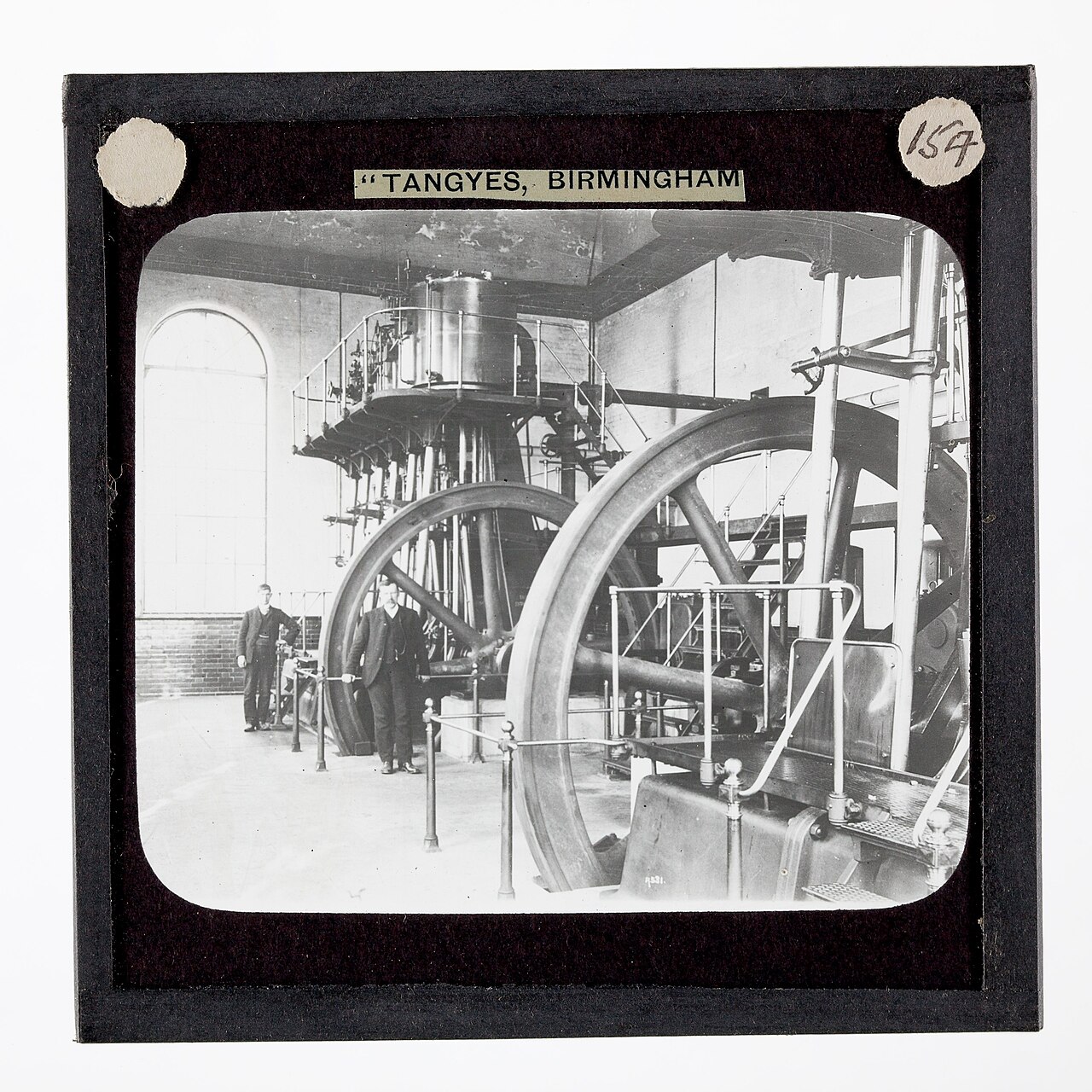
A Tangyes sales lantern slide from about 1910 records sewerage pumping as an engine-and-pump installation. The driver has changed; matching machine, duty and maintainability has not.
Public domainWikimedia Commons
6.3.2Five arrangements, five different compromises
| Type | Good fit | Disqualifier or cost |
|---|---|---|
| submersible non-clog centrifugal | wet well; compact wastewater station | maintenance requires lifting; cable/seal integrity matters |
| dry-pit centrifugal | accessible machine room; flooded suction | structure, ventilation, and flood risk |
| self-priming centrifugal | pump above source where suction lift is modest | priming volume, suction leakage, and reduced NPSH available |
| vertical turbine | deep potable source or clearwell; bowl assembly submerged | shaft/column alignment and removal headroom |
| Archimedean screw | large flow, low lift, tolerant open-channel wastewater duty | large civil footprint and exposed/open conveyance |
“Non-clog” is a product-family description, not immunity to ragging. Ask what object passes, through which section, at the selected trim. Cutter, chopper, vortex, and channel impellers manage solids in different ways and pay different efficiency and wear penalties. Upstream screening can change the allowable pump, but that belongs to the process design—not an assumption hidden in selection.
The screw survives because the duty survives
The Archimedean screw predates the centrifugal pump by centuries. It remains useful not from nostalgia but because large passages, low rotational speed, and low-lift open conveyance solve a duty that a small high-speed impeller may solve badly.A nominal sphere test describes one geometric clearance. Flexible wipes and stringy material interact with leading edges, clearances and recirculation differently.
Pair the stated passage with service references, impeller geometry and the upstream solids strategy.
6.3.3Solids passage and the hydraulic price
A larger free passage usually means fewer or more open vanes. That reduces blockage risk but weakens the guided diffusion that produces high efficiency. The selection is a lifecycle trade: blockage calls, lifting operations, rag removal, abrasive wear, energy, and the consequence of losing firm capacity. A passage dimension without the debris basis behind it is merely a catalogue filter.
For a worked comparison using ρ = 999 kg/m³, a 100 L/s duty through a conventional pump at 75% efficiency needs 34.75 kW at 26.6 m head; a more open 68% impeller at the same hydraulic duty needs 38.32 kW. The 3.58 kW difference is real, but one avoided blockage can dominate it. Reliability and energy belong in the same decision, with local labour and outage consequences stated.
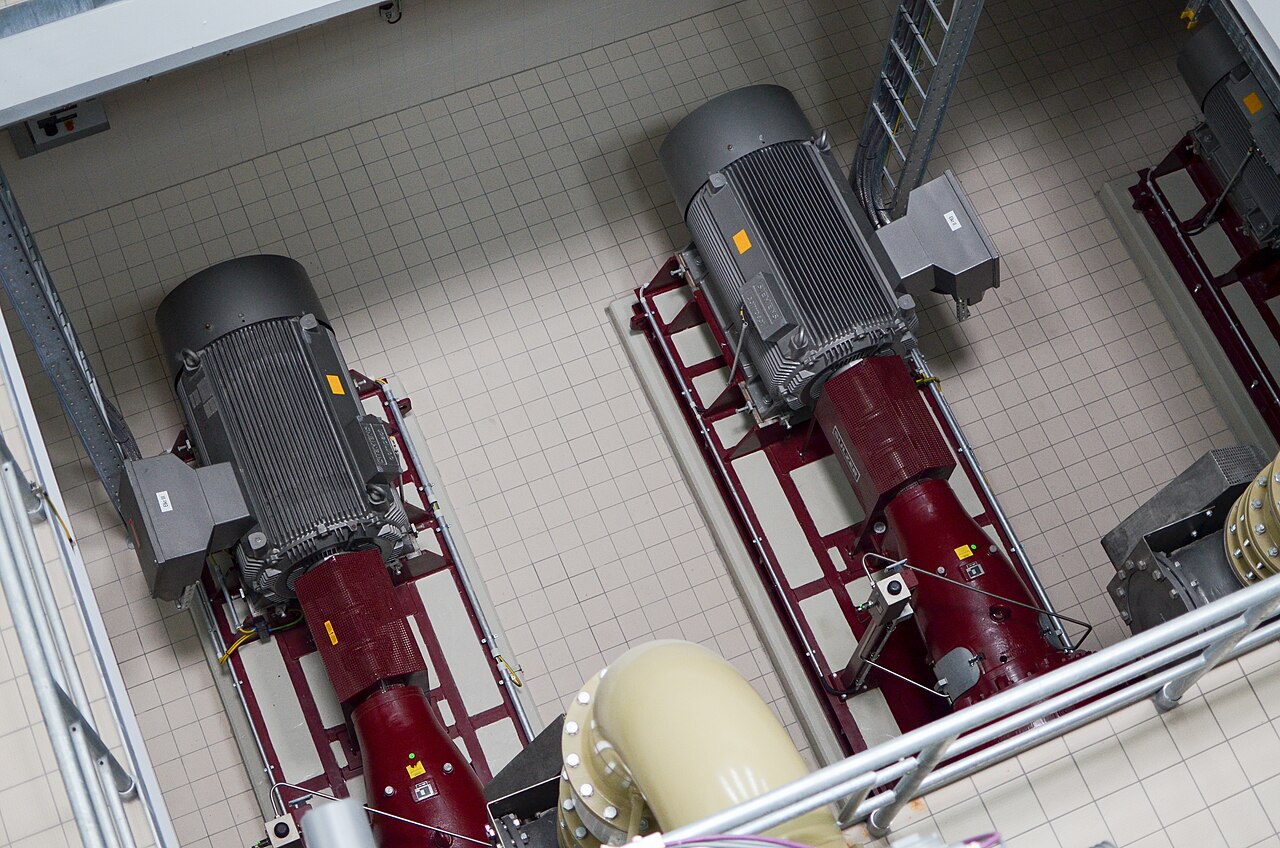
Modern dry-well sewage pumps make access, isolation and removal paths visible. A pump type is not selected from appearance, but the installed arrangement reveals what maintenance must reach.
Philip SteffanCC BY 4.0Wikimedia Commons
Interactive 3D instrument
Screen the pump
A 3D instrument you drive yourself, one variable at a time. It needs JavaScript and WebGL, so it is not shown in this static copy of the page.
6.3.4Potable approval is a separate axis
NSF/ANSI/CAN 61 evaluates health effects of substances imparted by drinking-water-contact materials; it does not certify pump hydraulic performance, taste and odour, or resistance to every water chemistry. The selected pump, coatings, elastomers, lubricants with credible contact, and replacement parts must satisfy the authority having jurisdiction. Lead-content requirements may also invoke NSF/ANSI/CAN 372 and the Safe Drinking Water Act.
Conversely, potable approval does not make a clear-water pump suitable for sewage. A narrow multi-vane impeller may be efficient and fully approved for drinking-water contact yet fail on the first rag. Record both axes: can the liquid pass? and may the liquid contact it?
Check your understanding
Disqualify before selecting
1 auto-graded question with an explanation for every wrong answer. Requires JavaScript. (m6-l3-q1)
Lab 6.3
Price the efficiency compromise
Write shaftKW(qLps, headM, efficiencyPct) using ρ = 999 kg/m³ and g = 9.80665 m/s². Graded in the browser against 2 assertions; the editor and harness require JavaScript.
Examination score
The scorecard totals this page’s graded work as you go. It requires JavaScript.
Head, Loss and Lift · Module 6, Lesson 3